
Summer Storms: Who really pays for hail, storm, and flood damage?
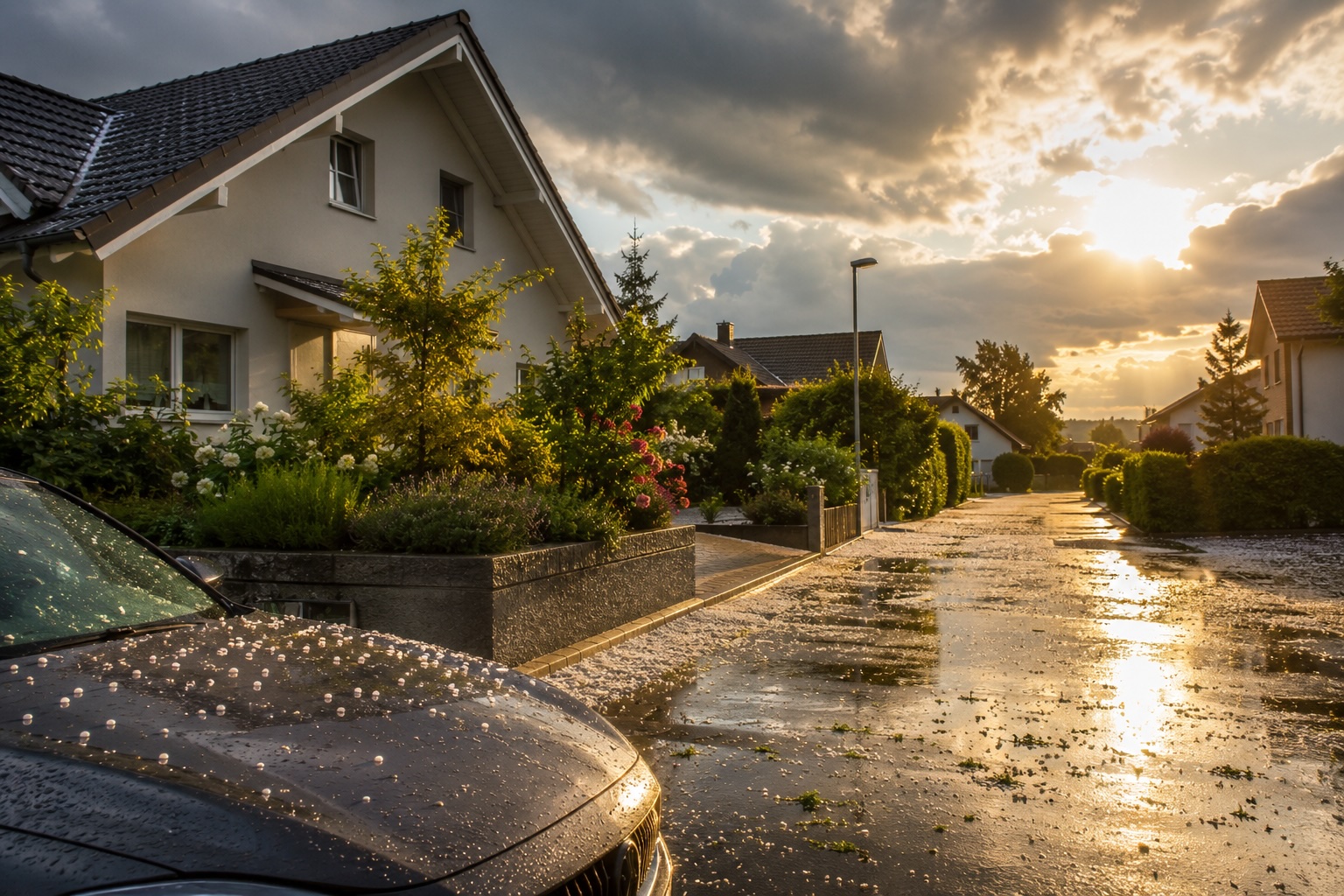
Around 25,000 lightning strikes in a few hours, a mudslide in Valais, flooded basements in the Zurich area, and trams temporarily at a standstill in Bern: The severe thunderstorms of late June and early July 2026 left their mark across large parts of Switzerland. Numerous vehicles, houses, and gardens were damaged. Once the storm passes, those affected quickly ask: Which insurance actually pays for what now? Our guide provides an overview.
What is natural hazard damage?
Hail, storms, and floods are considered natural hazard damage. Swiss legislation defines nine natural hazards: floods, inundation, storms from 75 km/h, hail, avalanches, snow pressure, rockfalls, rockslides, and landslides.
Natural hazard coverage is regulated by law in Switzerland and is generally linked to fire insurance. Therefore, if a building or household contents are insured against fire, the legally defined natural hazard damages are also included. However, whether such insurance must be taken out depends on the insured object and the respective canton: For buildings, it is mandatory in most cantons, while for household contents, it is generally voluntary. Exceptions are the cantons of Nidwalden, Vaud, Fribourg, and Jura.
Earthquakes are not among the legally defined natural hazards. Comprehensive insurance coverage against earthquake damage therefore usually requires separate coverage.
Which insurance pays for what?
After a storm, several insurance policies are often affected. What determines who covers the damage is what was damaged.
Damage to the building
If a storm rips off the roof or floodwaters push into the basement, the building insurance is responsible. In 19 cantons, it is mandatory through the cantonal building insurance. In the so-called GUSTAVO cantons (Geneva, Uri, Schwyz, Ticino, Appenzell Innerrhoden, Valais, Obwalden), however, owners insure their building with a private provider, sometimes mandatorily, sometimes voluntarily.
The basic coverage includes the building itself, i.e., the roof, facade, windows, and permanently installed fixtures, which usually also include permanently installed photovoltaic systems. However, certain risks require supplementary private property insurance for buildings: for example, for loss of earnings from a damaged solar system or for damage to the building’s surroundings.
Damage to household contents
For movable items in a private household, household contents insurance covers insured natural hazard events. This includes, for example, furniture, clothes, electronic devices, or one’s own washing machine in a flooded basement. Anyone who has taken out household contents insurance with fire protection is also insured against legally defined natural hazard damage.
Make sure that your sum insured corresponds to the actual value of your household contents. In case of underinsurance, the insurance company will proportionally reduce the benefit in the event of a claim.
Caution with water in the basement: Not every flood is natural hazard damage
A full basement is not automatically insured natural hazard damage. A flood in the legal sense only applies if water enters the building over the surface of the earth. Two common cases are not covered: rain entering through an open or leaky window, and water pushed back into the building through floor drains or toilets due to an overloaded sewage system (so-called backflow). Backflow damage requires separate water insurance, as part of private building water insurance for the building, and as corresponding additional coverage for household contents. Especially during severe summer storms with heavy rain, the sewage system can quickly become overloaded. Anyone living in a high-risk area or storing valuables in the basement should therefore check this coverage.
Damage to garden and surroundings
This is a common coverage gap. While garden furniture counts as household contents, the permanently installed surroundings – garden facilities, plantings, retaining walls, driveways, or the swimming pool – are usually not included in the basic coverage of building insurance. Simply put: coverage often ends at the house wall, regardless of whether you are cantonally or privately insured. This requires additional coverage for the building’s surroundings, as offered by private property insurance for buildings. Anyone who has invested a lot in their garden should be aware of this gap and check whether the additional protection is worthwhile.
And what about cars?
Not only buildings and household contents can be damaged by storms. Vehicles are also particularly vulnerable to hail, storms, and floods.
Mandatory liability insurance only covers damage you cause to others. For hail, storm, and flood damage to your own vehicle, you need at least partial comprehensive insurance. This usually covers the repair costs without you being downgraded in the bonus system.
Whether partial comprehensive insurance is worthwhile depends particularly on the value of the vehicle. For newer or more valuable cars, it is usually sensible. For very old vehicles with a low current value, however, waiving it can be worthwhile, as compensation for a total loss is limited. Therefore, it is worth taking a look at the vehicle value, premium, deductible, and insurance conditions.
Acting correctly in the event of a claim
After a storm, quick and thoughtful action is crucial:
- Document the damage: Photograph or film all damage before cleaning up. Dated pictures are the basis for any claims settlement.
- Prevent further damage: The law obliges you to keep the damage as low as possible, for example, by pumping out water or temporarily covering a damaged window. Keep the receipts – the costs for sensible immediate measures will be reimbursed by the insurance company.
- Report immediately: Inform your insurance company as quickly as possible, by phone or online. Anyone who culpably delays reporting risks a reduction in compensation.
- Keep damaged items: Only dispose of damaged items once the insurance company has assessed the damage or given its approval.
- Create a list: For household contents damage, list all affected items with their approximate purchase value.
Close coverage gaps now, not just after the next storm
The storms of summer 2026 show: natural hazards regularly affect Switzerland, often with little warning. Whether your protection is sufficient in an emergency is not decided during the storm, but when you take out the policy. Typical weaknesses include an insufficient sum insured for household contents, a missing partial comprehensive insurance for the car, or uncovered garden surroundings.
A quick insurance check provides clarity before the next summer storm approaches. The simply advisors will take the time, without obligation, to check your household contents, building, and vehicle protection against natural hazards and show you where gaps can be closed.
 Fact sheet on outpatient supplementary insurance